
Common excavator structures include power units, working devices, slewing mechanisms, operating mechanisms, transmission mechanisms, walking mechanisms and auxiliary facilities.
The transmission mechanism transmits the power of the engine to the hydraulic motor, hydraulic cylinder and other actuators through the hydraulic pump, and pushes the working device to move, thereby completing various operations.
Walking device
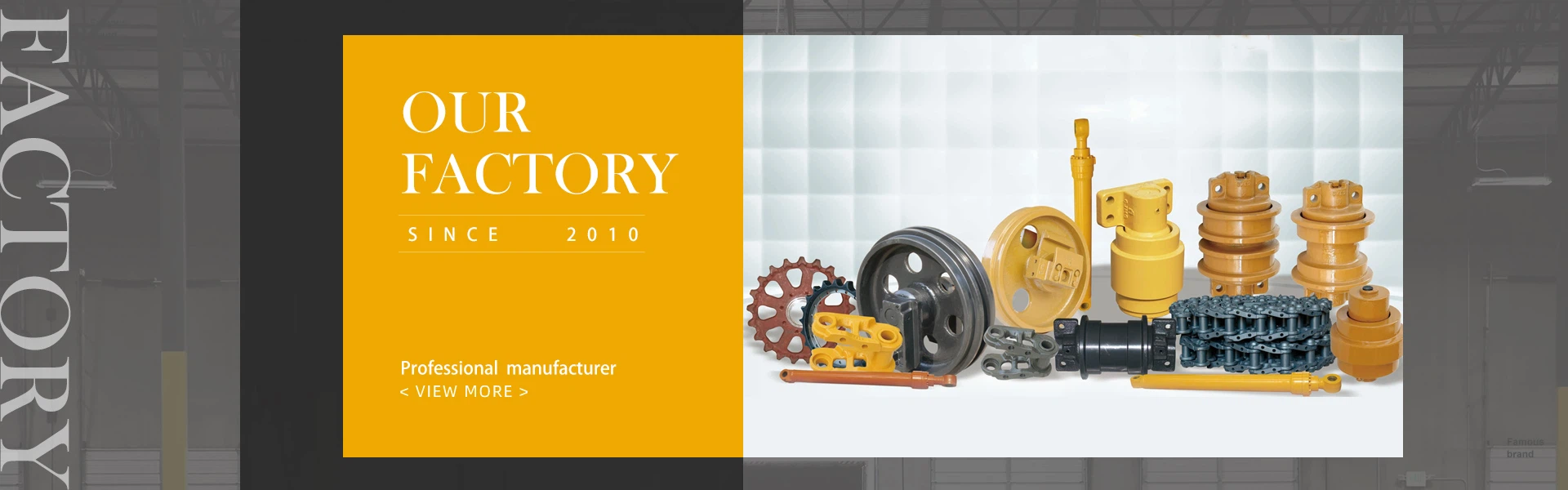
The walking device is the chassis, including the crawler frame and the walking system, which is mainly composed of the crawler frame, the walking motor + reducer and its pipeline, the driving wheel, the guide wheel, the carrier wheel, the roller, the crawler, and the tensioning buffer device. The function is to support the weight of the excavator, and convert the power transmitted by the driving wheel into traction, so as to realize the walking of the whole machine.
The frame assembly (that is, the crawler walking frame assembly) is an integral welded part and adopts an X-shaped structure. Its main advantage is that it has a high bearing capacity. The frame assembly is welded by three parts: the left longitudinal beam (ie the left track frame), the main frame (ie the middle frame) and the right longitudinal beam (ie the right track frame). The weight of the frame assembly is 2 tons.
The central rotary joint is the hydraulic component connecting the rotary platform and the oil circuit of the chassis. It ensures that after the rotary platform rotates at any angle, the travel motor can still distribute oil normally. The current rotary joint is 5-way.
Working equipment
The working device is the main part of the hydraulic excavator. At present, the SY series excavator is equipped with a backhoe working device, which is mainly used to excavate the soil below the parking surface, but it can also excavate the soil below the maximum cutting height. In addition to ditching and loading, it can also perform simple field leveling work. The excavation operation is suitable for excavating the soil of grade Ⅰ~Ⅳ, and the hydraulic hammer or blasting method is required for the above grade Ⅴ.
The backhoe working device is composed of boom, stick, bucket, rocker, connecting rod and hydraulic pipelines of the working device including boom cylinder, stick cylinder and bucket cylinder.
Power Transmission Route Table
1. Walking power transmission route: diesel engine - coupling - hydraulic pump (mechanical energy is converted into hydraulic energy) - distribution valve - central rotary joint - walking motor (hydraulic energy is converted into mechanical energy) - reduction box - driving wheel ——Rail chain crawler——to realize walking
2. Slewing motion transmission route: diesel engine - coupling - hydraulic pump (mechanical energy is converted into hydraulic energy) - distribution valve - slewing motor (hydraulic energy is converted into mechanical energy) - reduction box - slewing bearing - realize rotation
3. Boom motion transmission route: diesel engine - coupling - hydraulic pump (mechanical energy is converted into hydraulic energy) - distribution valve - boom cylinder (hydraulic energy is converted into mechanical energy) - realization of boom movement
4. Stick movement transmission route: diesel engine—coupling—hydraulic pump (mechanical energy is converted into hydraulic energy)—distribution valve—stick cylinder (hydraulic energy is converted into mechanical energy)—the stick movement is realized
5. Bucket motion transmission route: diesel engine - coupling - hydraulic pump (mechanical energy is converted into hydraulic energy) - distribution valve - bucket cylinder (hydraulic energy is converted into mechanical energy) - bucket motion is realized
The composition and function of the power system
·Intake system——net cover→hose→air filter→hose→supercharger→hose→intercooler→hose→engine
Exhaust system - supercharger → expansion joint → muffler → exhaust pipe
·Cooling system - water tank→hose→thermostat→water pump→diesel engine→hose→water tank
Throttle control system - stepper motor → reducer → worm gear drive → throttle cable → diesel throttle - high idle speed, low idle speed limit switch
·Fuel System--
Oil inlet system: fuel tank → hose → hand pump → coarse filter → fine filter → diesel engine
Oil return system: diesel engine → hose → fuel tank (the amount of oil returned is relatively large, and it is used for partial cooling)